Residential & Commercial Evictions | You are represented at all times by one of our California Eviction Attorneys | 1-800-686-8686 | intake@fastevict.com | Se habla español

Accessible Parking at Apartment Buildings: A Landlord’s Guide to ADA and Fair Housing Rules

Accessible parking is one of the most overlooked compliance areas for apartment owners, yet it is one of the most common sources of complaints, inspections, and legal exposure. Many landlords assume that once spaces are painted and signs are installed, the job is done. In reality, accessible parking requirements for landlords go far beyond striping spaces. They include proper placement, accessible routes, maintenance, and handling tenant requests under fair housing laws.
For California landlords and property managers, understanding how ADA parking requirements and Fair Housing rules intersect is essential to protecting your property, reducing risk, and maintaining a professional, well-managed community.
Key Takeaways
- Accessible parking requirements for landlords depend on both ADA rules and Fair Housing obligations.
- Parking must be evaluated per parking area, not just the entire property.
- At least one out of every six accessible spaces must be van accessible.
- Accessible spaces must connect to entrances through a compliant accessible route.
- California landlords must also handle reasonable accommodation requests for parking.
- Ongoing maintenance, documentation, and staff awareness are critical for compliance.
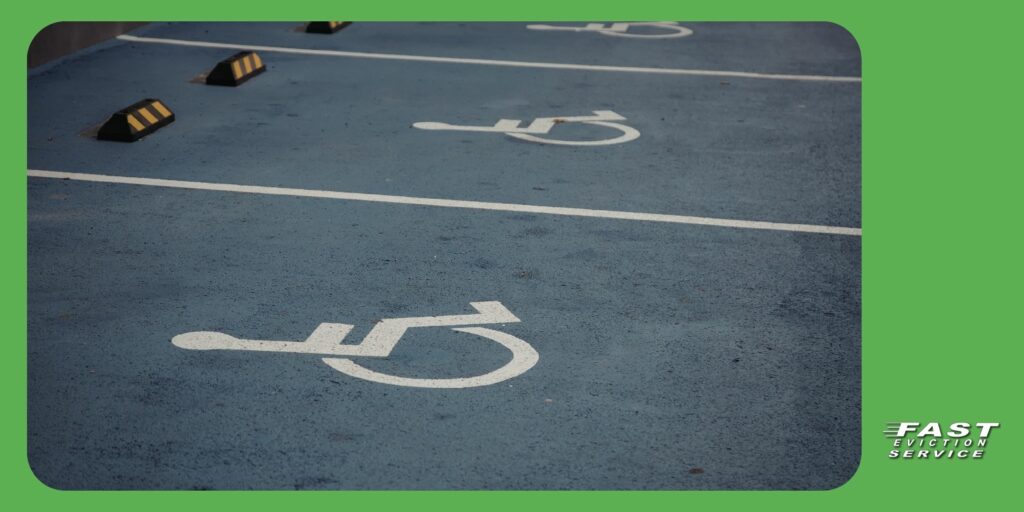
Table of Contents
- ADA vs Fair Housing, Understanding the Difference
- How Many Accessible Parking Spaces Are Required
- Van Accessible Parking Requirements
- Accessible Routes, The Most Overlooked Requirement
- Signage, Striping, and Access Aisles
- California Landlord Considerations
- Handling Tenant Parking Accommodation Requests
- Maintenance and Compliance Checklist
- Common Mistakes Landlords Should Avoid
- Conclusion
ADA vs Fair Housing, Understanding the Difference
One of the biggest mistakes landlords make is assuming there is only one set of rules for accessible parking. In reality, there are two primary frameworks.
The Americans with Disabilities Act, or ADA, generally applies to public facing areas of your property. This includes leasing offices, visitor parking, and amenities that prospective tenants may access.
The Fair Housing Act, along with California’s Fair Employment and Housing Act, applies to residential use. This includes tenant parking areas, assigned spaces, and accommodation requests.
For landlords, this distinction matters because a property may need to comply with both sets of rules at the same time. For example, your leasing office parking may follow ADA ratios, while tenant parking may require adjustments based on accommodation requests.
How Many Accessible Parking Spaces Are Required
Accessible parking requirements for landlords are based on the number of parking spaces in each individual parking facility. This means each lot or garage must be evaluated separately, not the entire property as a whole.
For smaller parking areas, at least one accessible space is typically required. As the number of spaces increases, the number of required accessible spaces increases as well.
For larger apartment communities with multiple buildings and parking areas, this becomes especially important. Each parking lot serving a specific building should have accessible spaces located near that building’s entrance.
This approach ensures that accessible parking is actually usable, rather than concentrated in one distant area of the property.
Van Accessible Parking Requirements
Not all accessible spaces are the same. A portion of them must be designed for vans, which require additional space for ramps and mobility equipment.
In general, one out of every six accessible parking spaces must be van accessible. If your property only requires one accessible space, that space must typically be van accessible.
Van accessible spaces require wider dimensions and access aisles. These spaces must also provide sufficient vertical clearance, especially in parking structures or garages.
For landlords, the key takeaway is simple. It is not enough to meet the total number of accessible spaces. You must also ensure the correct mix of standard and van accessible spaces.
Accessible Routes, The Most Overlooked Requirement
Many landlords focus heavily on parking spaces themselves but overlook what happens after a tenant or visitor exits their vehicle.
An accessible parking space must connect to an accessible route that leads to the building entrance. This route must be continuous, stable, and wide enough for mobility devices.
The route should follow the shortest accessible path to the entrance. It cannot require individuals with disabilities to take a longer or more difficult route than others.
Accessible routes should also connect to common areas such as laundry rooms, mailboxes, and amenities. For California landlords, this is particularly important in larger apartment communities where amenities are spread out.
If the route is blocked, uneven, or poorly maintained, the parking space itself may not be considered functional.
Signage, Striping, and Access Aisles
Proper signage and striping are essential for maintaining compliance and preventing misuse of accessible spaces.
Accessible parking spaces must be clearly marked with the International Symbol of Accessibility. Van accessible spaces must include additional designation.
Access aisles are the striped areas next to accessible spaces. These are not extra parking spaces. They are critical for allowing individuals to safely enter and exit vehicles.
These aisles must remain clear at all times and be properly marked to discourage misuse.
For landlords, consistent enforcement and maintenance of these areas can significantly reduce tenant complaints and improve overall property organization.
California Landlord Considerations
California landlords operate in one of the most regulated environments in the country. While federal ADA standards establish a baseline, California laws and local ordinances may impose additional requirements.
Landlords should be aware that:
- Local jurisdictions may have stricter accessibility standards.
- Inspections may occur during renovations, complaints, or permitting.
- Documentation of compliance efforts can be important in resolving disputes.
Because of this, it is important to periodically review parking layouts, especially after restriping, renovations, or changes in parking assignments.
Handling Tenant Parking Accommodation Requests
Under Fair Housing laws, tenants may request reasonable accommodations related to parking.
This can include:
- A reserved accessible parking space near their unit
- A reassignment of parking to reduce walking distance
- Modifications to parking arrangements
For landlords, the process should be consistent and documented. Requests should be reviewed promptly, and communication should remain professional and clear.
Even properties with first come first served parking policies may need to make exceptions in certain situations.
Handling these requests properly can help reduce disputes and demonstrate good faith compliance.
Maintenance and Compliance Checklist
Accessible parking is not a one time task. It requires ongoing attention.
Landlords should regularly:
- Inspect parking spaces for faded markings
- Ensure signage is visible and not obstructed
- Keep access aisles clear of vehicles and debris
- Maintain smooth, stable surfaces
- Ensure accessible routes remain unobstructed
- Review lighting conditions for safety
Creating a simple inspection schedule can help prevent small issues from becoming larger compliance concerns.
Common Mistakes Landlords Should Avoid
Many compliance issues arise from simple oversights.
Common mistakes include:
- Calculating accessible spaces based on the entire property instead of each parking area
- Failing to include van accessible spaces
- Placing accessible spaces too far from entrances
- Allowing vehicles to block access aisles
- Ignoring tenant accommodation requests
- Failing to maintain markings and signage
Avoiding these issues can significantly reduce risk and improve tenant satisfaction.
Conclusion
Accessible parking requirements for landlords are more complex than they appear at first glance. Between ADA standards, Fair Housing obligations, and California-specific considerations, landlords must take a proactive approach.
By understanding how these rules apply to your property, maintaining your parking areas, and responding appropriately to tenant needs, you can reduce risk and create a more functional and professional apartment community.