Residential & Commercial Evictions | You are represented at all times by one of our California Eviction Attorneys | 1-800-686-8686 | intake@fastevict.com | Se habla español

California 3-Day Notice Mistakes That Can Get an Eviction Case Dismissed

A tenant has stopped paying rent, violated the rental agreement, or repeatedly caused problems at your rental property. You have documentation, a signed lease, and legitimate grounds for eviction. However, a seemingly minor mistake on your 3-day notice could jeopardize your entire eviction case.
One of the most frustrating aspects of the California eviction process is that having a legitimate reason to evict a tenant does not automatically mean a landlord will prevail in court. An incorrect rent demand, missing payment instructions, improper service, or miscalculated deadline can result in additional expenses, lost rental income, and potentially a dismissed unlawful detainer case.
Understanding common California eviction notice mistakes can help landlords and property managers identify potential problems before they become costly legal disputes. This is particularly important in Southern California, where state laws, local eviction ordinances, and federal housing regulations can create overlapping requirements.
Key Takeaways
- California has several types of 3-day eviction notices, each designed for different circumstances.
- A 3-Day Notice to Pay Rent or Quit generally cannot include late fees, utilities, property damage charges, or other non-rent expenses.
- Saturdays, Sundays, and judicial holidays are excluded when calculating the notice period for nonpayment and curable lease violations.
- Improper notice service and insufficient proof of service can undermine an otherwise valid eviction case.
- AB 1482 and local just cause eviction ordinances may impose additional notice requirements.
- Los Angeles landlords may need to satisfy minimum unpaid rent thresholds and file applicable termination notices with the Los Angeles Housing Department.
- Accepting rent after serving an eviction notice may affect the landlord’s ability to proceed.
- A materially defective eviction notice may require the landlord to restart the notice process.

Table of Contents
- Why California Eviction Notices Are So Important
- Serving the Wrong Type of 3-Day Notice
- Demanding the Incorrect Amount of Rent
- Including Illegal Eviction Notice Delivery Fees
- Leaving Required Information Out of the Notice
- Miscalculating the 3-Day Notice Period
- Improperly Serving an Eviction Notice
- Failing to Maintain Proper Proof of Service
- Ignoring California’s Just Cause Eviction Requirements
- Overlooking Local and Federal Eviction Regulations
- Accepting Rent After Serving an Eviction Notice
- Overlooking Retaliation, Discrimination, and Habitability Issues
- Filing an Unlawful Detainer Lawsuit Too Early
- What Happens When a California Eviction Notice Is Invalid?
- California 3-Day Notice Checklist for Landlords
- Frequently Asked Questions
Why California Eviction Notices Are So Important
An eviction notice is much more than a written warning to a tenant. It establishes the foundation for a potential unlawful detainer lawsuit, which is the legal proceeding California landlords generally use to recover possession of a rental property.
Unlike an ordinary dispute over an unpaid debt, unlawful detainer proceedings follow specific procedural requirements. Landlords must establish that the appropriate notice was provided, that its contents satisfied applicable requirements, and that the tenant received the full legally required notice period.
The underlying reason for eviction and the validity of the eviction notice are separate issues. A tenant may owe several months of rent, but an improperly prepared notice can still prevent a landlord from recovering possession through the pending case.
The California Courts’ eviction notice guide specifically identifies incomplete or inaccurate notices as potential reasons landlords may lose their eviction cases.
The financial consequences of a defective eviction notice
For landlords, a defective eviction notice can create a significant financial setback. When an eviction must be restarted, the property may continue generating little or no rental income while the owner remains responsible for operating expenses.
Mortgage payments, property taxes, insurance premiums, association fees, and maintenance expenses do not stop simply because an eviction case encounters a procedural problem.
A dismissed eviction case may also involve additional court filing fees, notice preparation expenses, attorney fees, and service costs.
Understanding the California eviction notice requirements is an important part of managing these financial risks.
Serving the Wrong Type of 3-Day Notice
Not every lease violation or rental dispute can be addressed using the same eviction notice. California recognizes several types of 3-day notices, and each serves a different purpose.
One of the most common California eviction notice mistakes occurs when landlords select a notice based on how quickly they want the tenant to leave rather than the circumstances surrounding the violation.
Understanding the three types of California 3-day notices
| Notice type | General purpose | Opportunity to correct the problem |
| 3-Day Notice to Pay Rent or Quit | Unpaid rent | Yes |
| 3-Day Notice to Perform Covenants or Quit | Correctable lease violations | Yes |
| 3-Day Unconditional Notice to Quit | Qualifying serious or noncurable violations | Generally no |
3-Day Notice to Pay Rent or Quit
A 3-Day Notice to Pay Rent or Quit is generally used when a residential tenant fails to pay rent.
The notice gives the tenant an opportunity to satisfy the eligible outstanding rent balance or surrender possession of the property within the applicable notice period.
It is not a general debt collection notice and cannot be used to demand every outstanding charge appearing on the tenant’s account.
3-Day Notice to Perform Covenants or Quit
This notice generally addresses material lease violations that can be corrected. Examples may include unauthorized pets, certain unauthorized occupants, prohibited property uses, or recurring violations of rental agreement provisions.
The 3-Day Notice to Perform Covenants or Quit identifies the violation and provides an opportunity for the tenant to remedy the problem.
When applicable law requires an opportunity to cure, immediately demanding that the tenant vacate may create a defective eviction notice.
3-Day Unconditional Notice to Quit
An unconditional notice generally involves qualifying serious violations, such as significant property damage constituting waste, certain unlawful activities, or conduct that legally constitutes a nuisance.
Unlike a curable notice, an unconditional notice does not ordinarily provide another opportunity to correct the underlying violation.
However, the fact that a landlord considers a violation serious does not necessarily establish grounds for an unconditional notice. State and local eviction protections may require warning notices, opportunities to cure, or other preliminary procedures.
Selecting the wrong notice can create problems before the eviction case even reaches the courtroom.
Demanding the Incorrect Amount of Rent
When a tenant falls behind on rent, it is understandable that a landlord wants to recover the entire outstanding balance. Unfortunately, the amount showing on a tenant’s account is not necessarily the amount that belongs on a 3-Day Notice to Pay Rent or Quit.
Under California Code of Civil Procedure Section 1161, the rent demand must accurately reflect the eligible unpaid rent.
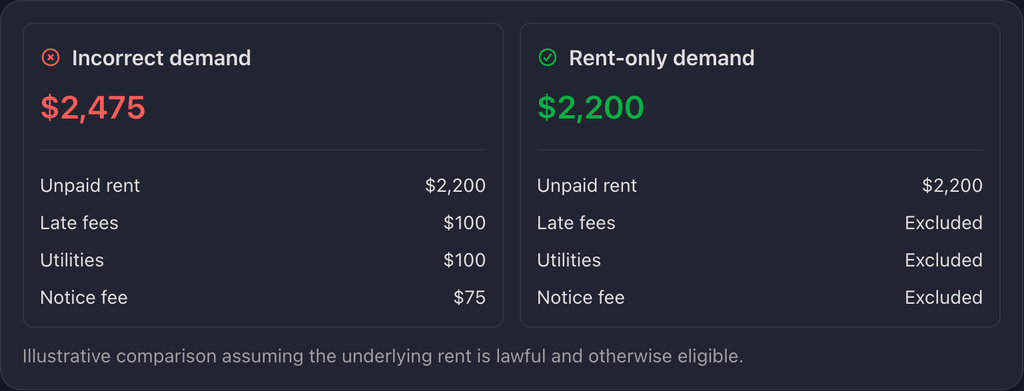
Demanding more than the tenant legally owes in rent can provide grounds for challenging the notice.
Including charges that are not rent
A residential 3-Day Notice to Pay Rent or Quit generally cannot include additional charges such as:
- Late rent payment fees.
- Utility charges.
- Property damage expenses.
- Returned check fees.
- Administrative charges.
- Notice preparation and delivery fees.
- Other charges that do not legally qualify as rent.
Consider a landlord whose tenant has failed to pay two months of rent. The property management software shows an outstanding balance of $4,820.
| Outstanding charge | Amount | Included in hypothetical rent demand |
| October rent | $2,200 | Yes |
| November rent | $2,200 | Yes |
| Late fees | $200 | No |
| Outstanding utilities | $145 | No |
| Returned payment fee | $75 | No |
| Total outstanding balance | $4,820 | |
| Eligible unpaid rent | $4,400 |
Assuming the rent was lawfully charged and no other credits or restrictions apply, the eligible rent demand in this example would be $4,400 rather than the entire outstanding balance.
Other amounts may remain collectible through separate procedures, provided they are legally owed.
Failing to account for partial payments and credits
Accounting errors are another common source of defective eviction notices.
A tenant may have made a partial payment that was not properly recorded. A rental assistance payment may have been received but not credited to the account. A rent concession or accounting adjustment may have been overlooked.
Even a relatively small discrepancy can create a significant problem when the amount demanded is inaccurate.
This is especially relevant for property managers overseeing multiple rental units, where automated accounting systems may combine rent, fees, credits, and other charges into a single outstanding balance.
A detailed, up-to-date rent ledger helps distinguish actual unpaid rent from other financial obligations.
Demanding rent based on an unlawful rent increase
The accuracy of a rent demand also depends on whether the underlying rent was lawfully established.
For example, a landlord may have increased the monthly rent without complying with applicable notice requirements or exceeded the maximum increase permitted under AB 1482 or a local rent stabilization ordinance.
If the tenant’s legally enforceable rent differs from the amount recorded in the property management system, the resulting 3-day notice may contain an inaccurate demand.
California landlords operating in rent-controlled jurisdictions face additional considerations because local rent increase restrictions may be more restrictive than statewide requirements.
Including rent that is more than one year overdue
California Code of Civil Procedure Section 1161(2) generally limits nonpayment eviction notices to rent that became due within the preceding year.
This does not necessarily mean that older unpaid rent is no longer collectible. Instead, recovering possession of a rental property and collecting outstanding rental debt are distinct legal objectives.
Depending on the circumstances, older rental debt may require a separate collection action.
Landlords can learn more about the distinction in our article on recovering unpaid rent and damages after an eviction in California.
Including Illegal Eviction Notice Delivery Fees
California landlords should also be aware of changes introduced by Senate Bill 611, which became effective in 2025.
Beginning February 1, 2025, California prohibits landlords and their agents from charging tenants a fee for serving, posting, or otherwise delivering eviction notices described under Code of Civil Procedure Section 1161.
Before this change, some landlords and property management companies passed notice-related expenses along to tenants. These charges sometimes appeared on rental ledgers as notice fees, posting fees, or administrative service charges.
Under SB 611, this practice is prohibited for the covered notices.
The distinction is important because the cost of having an eviction notice professionally prepared or served does not automatically become a financial obligation that can be charged to the tenant.
Property managers using older rental agreement templates or automated accounting systems may encounter issues when these charges continue to be generated automatically.
Including prohibited fees in a rent demand can create additional compliance problems while also undermining the accuracy of the eviction notice.
Leaving Required Information Out of the Notice
A California eviction notice must communicate more than the fact that a landlord wants a tenant to pay rent or vacate the rental property.
The document must contain the information required for the specific notice type and applicable jurisdiction.
Missing information on a 3-Day Notice to Pay Rent or Quit
A properly prepared residential nonpayment notice generally includes the tenant’s identifying information, the rental property address, the eligible unpaid rent balance, the required payment deadline, and applicable payment instructions.
Section 1161 also establishes requirements concerning the identity, telephone number, and address of the person authorized to receive rent.
When payment is available in person, the notice must contain the applicable information regarding when and where payment can be made. The statute also recognizes certain qualifying bank deposit arrangements and previously established electronic payment procedures.
An outdated management company address, disconnected telephone number, incorrect apartment number, or incomplete payment instructions can create unnecessary disputes regarding the tenant’s ability to comply.
Providing vague descriptions of lease violations
The same principle applies to a 3-Day Notice to Perform Covenants or Quit.
A notice that simply states that a tenant has violated the rental agreement may not adequately describe the alleged violation or what compliance requires.
Consider a situation involving repeated noise complaints at an apartment complex. A general statement accusing the tenant of being disruptive provides less useful information than a documented description identifying relevant incidents, dates, and the applicable rental agreement provisions.
The stronger the underlying documentation, the easier it may be to establish the factual basis for the notice if the tenant disputes the allegations.
Using outdated eviction notice templates
California rental housing laws change regularly. A notice template that was commonly used several years ago may no longer contain the language required under current state or local law.
This is particularly important for landlords managing properties across several Southern California cities.
A notice used for a rental property in Riverside may not contain the additional information required for a covered rental unit in Los Angeles, Pasadena, or Santa Monica.
Using a generic California eviction notice without accounting for jurisdiction-specific requirements can expose landlords to avoidable compliance issues.
Miscalculating the 3-Day Notice Period
Does a 3-day eviction notice really mean three days?
Not necessarily.
One of the most common California eviction notice mistakes involves misunderstanding how the notice period is calculated.
Landlords who count the notice period incorrectly may begin an unlawful detainer action before the tenant’s legally permitted time to comply has expired.
Do weekends and holidays count toward a California 3-day notice?
California’s counting rules depend on the type of eviction notice.
| Eviction notice | Saturdays and Sundays | Judicial holidays |
| 3-Day Notice to Pay Rent or Quit | Excluded | Excluded |
| 3-Day Notice to Perform Covenants or Quit | Excluded | Excluded |
| 3-Day Unconditional Notice to Quit | Generally counted | Generally counted |
Unconditional notices remain subject to applicable final-day deadline rules. When the last day falls on a weekend or judicial holiday, the deadline generally extends to the next court day.
Our article explaining how days are counted in California 3-day notices provides additional background on these requirements.
Example of a California 3-Day Notice to Pay Rent or Quit
Suppose a landlord personally serves a 3-Day Notice to Pay Rent or Quit on Thursday, with no intervening judicial holidays or additional applicable notice requirements.
Understanding the 3-day notice timeline

Hypothetical personal service example with no intervening judicial holidays.
In this example, Friday is the first day, Monday is the second day, and Tuesday is the third day. The tenant has through Tuesday to comply with the notice.
Wednesday may be the earliest potential filing date, assuming the notice was valid, the tenant failed to comply, and all other applicable requirements were satisfied.
Overlooking judicial holidays
Another important consideration is that judicial holidays do not always correspond with an individual landlord’s or property management company’s operating schedule.
A management office may be open on a day when California courts are observing a holiday.
The California Courts judicial holiday calendar is a useful resource for understanding how court holidays can affect eviction notice deadlines.
Improperly Serving an Eviction Notice
Preparing an accurate eviction notice is only part of the process. The manner in which the notice is delivered is equally important.
California Code of Civil Procedure Section 1162 establishes methods for serving certain eviction notices on residential tenants.
Improper service of an eviction notice in California can undermine the landlord’s ability to establish that the tenant received the required opportunity to comply.
California eviction notice service methods
Personal service
The notice is delivered directly to the tenant.
Substituted service
Under qualifying circumstances, the notice is delivered to another person of suitable age and discretion, with a copy also mailed as required.
Posting and mailing
When the statutory conditions are satisfied, a notice is posted conspicuously at the rental premises and a copy is mailed.
These methods are subject to different conditions. Posting a notice on the front door is not necessarily an acceptable substitute for personal delivery simply because it is more convenient.
The California Courts’ notice delivery guidelines provide additional information about statutory delivery procedures and documentation.
Common eviction notice service mistakes
Property owners sometimes rely on methods that work well for ordinary tenant communications but do not satisfy statutory eviction notice service requirements.
For example, landlords may regularly communicate with tenants through email, text messages, or online resident portals. However, these communication methods generally do not replace the required statutory delivery of an eviction notice.
Other common problems include posting a notice without mailing the required copy, delivering the notice to an incorrect rental unit, or failing to establish the conditions necessary for substituted service.
When a tenant disputes the delivery method, the landlord’s documentation may become particularly important.
Failing to Maintain Proper Proof of Service
Imagine preparing an accurate 3-day notice, delivering it properly, and waiting for the applicable notice period to expire, only to discover that there is insufficient documentation establishing when or how the notice was served.
This situation can create unnecessary complications during an unlawful detainer proceeding.
Proof of service establishes the circumstances surrounding the delivery of the eviction notice. It is particularly valuable when a tenant disputes receiving the document or challenges the expiration date.
What information belongs in an eviction notice service record?
A detailed service record generally documents:
- The identity of the person who delivered the notice.
- The type of notice served.
- The service date and location.
- The method of delivery.
- Relevant service attempts.
- Information concerning substituted service, when applicable.
- Mailing dates and addresses, when required.
- A signed and dated declaration.
Retaining the exact version of the notice that was served is equally important. A landlord’s records should accurately reflect the document the tenant received rather than a subsequently edited version.
Learn more about documenting notice delivery in our guide to California declarations of service and proof of service.
Why documentation matters in eviction court
When a tenant claims that a notice was never received, a landlord may need to establish that the applicable statutory method was completed.
Accurate proof of service helps support the landlord’s position regarding delivery, the beginning of the notice period, and the potential expiration date.
Proof of service for an eviction notice should not be confused with proof of service for an unlawful detainer summons and complaint. These are separate stages of the California eviction process with different procedural requirements.
Ignoring California’s Just Cause Eviction Requirements
The California Tenant Protection Act, commonly known as AB 1482, changed how many residential landlords can terminate tenancies throughout the state.
Under Civil Code Section 1946.2, landlords of covered rental properties must establish a legally recognized reason for terminating a tenancy once the applicable occupancy requirements have been met.
For landlords serving a 3-day notice, this means that the underlying violation must support the stated grounds for eviction and that any required preliminary procedures must be completed.
Understanding when AB 1482 applies
Many California residential rental properties are subject to statewide just cause eviction protections. Certain properties may qualify for exemptions, depending on factors such as ownership structure, property type, construction date, and required exemption disclosures.
A common mistake involves assuming that a single-family rental home or condominium is automatically exempt from AB 1482. These exemptions are subject to specific conditions, including ownership restrictions and written disclosure requirements.
Additionally, exemption from statewide rent control does not necessarily establish exemption from every applicable local eviction regulation.
The California Attorney General’s landlord-tenant resources provide an overview of statewide protections and exemptions.
Failing to provide an opportunity to cure
When the Tenant Protection Act applies and the eviction involves a curable lease violation, landlords must generally provide the legally required opportunity to correct the violation before proceeding with an unconditional termination notice.
For example, a tenant may have an unauthorized pet in violation of the rental agreement. Depending on the circumstances, including any applicable reasonable accommodation requirements, the landlord may be required to provide an opportunity to resolve the violation rather than immediately demand possession.
If the tenant fails to correct the qualifying violation within the applicable period, a subsequent unconditional notice may be required.
Skipping this stage can undermine an eviction case, even when the original lease violation is documented.
Confusing at-fault and no-fault evictions
California distinguishes between at-fault and no-fault grounds for terminating covered tenancies.
| At-fault eviction grounds | No-fault eviction grounds |
| Nonpayment of rent | Qualifying owner move-in |
| Material lease violations | Qualifying substantial remodel |
| Nuisance | Withdrawal from the rental market |
| Qualifying unlawful activity | Certain government orders |
| Waste or significant property damage | Qualifying demolition |
A 3-day notice is not a substitute for the notice and relocation requirements associated with a no-fault eviction.
Senate Bill 567 strengthened requirements for certain no-fault evictions beginning April 1, 2024. Assembly Bill 1529 subsequently amended Civil Code Section 1946.2, including provisions concerning Tenant Protection Act disclosures, effective January 1, 2026.
Landlords using older forms or relying on outdated interpretations of California rental laws may overlook these changes.
For additional information, read our article on understanding just cause evictions in California.
Overlooking Local and Federal Eviction Regulations
One of the biggest challenges for Southern California landlords is that eviction requirements can vary significantly depending on the property’s location and participation in federal housing programs.
A notice that satisfies general California eviction notice requirements may still be insufficient under an applicable local ordinance or federal law.
City of Los Angeles 3-day notice requirements
Landlords with properties subject to the City of Los Angeles Rent Stabilization Ordinance (RSO) or Just Cause Ordinance (JCO) face additional requirements when terminating tenancies.
These requirements can include notice filing obligations, minimum unpaid rent thresholds, additional disclosures, rental registration requirements, and specific grounds for eviction.
Filing eviction notices with LAHD
Applicable notices terminating tenancies must be filed with the Los Angeles Housing Department within three business days after service on the tenant.
This requirement is separate from delivering the notice to the tenant.
A landlord may properly serve an eviction notice and still encounter problems if the applicable LAHD filing requirement is overlooked. Failure to comply may provide the tenant with an affirmative defense during an unlawful detainer proceeding.
The Los Angeles Housing Department’s eviction notice filing portal provides information about submitting applicable notices.
Minimum unpaid rent thresholds in Los Angeles
Unlike many other California jurisdictions, the City of Los Angeles restricts certain nonpayment evictions based on the amount of outstanding rent.
For applicable properties, unpaid rent must exceed one month’s Fair Market Rent (FMR), as established by the U.S. Department of Housing and Urban Development for an equivalent-sized rental unit.
The applicable nonpayment notice must also identify the number of bedrooms in the rental unit.
The following thresholds apply from October 1, 2026, through September 30, 2027.
| Rental unit size | Fair Market Rent threshold |
| Studio / Efficiency | $2,151 |
| 1 bedroom | $2,402 |
| 2 bedrooms | $2,964 |
| 3 bedrooms | $3,760 |
| 4 bedrooms | $4,208 |
Source: Los Angeles Housing Department Renter Protections Notification.
For example, suppose a tenant renting a one-bedroom Los Angeles apartment owes $2,000 in unpaid rent. Although the tenant is delinquent, the amount does not exceed the applicable $2,402 eviction threshold.
This illustrates why unpaid rent alone does not necessarily establish eligibility for a nonpayment eviction in Los Angeles.
Additional Los Angeles notice requirements
Beginning August 20, 2025, applicable Los Angeles landlords must also provide the city’s Notice of Right to Counsel at the beginning of the tenancy and when serving an eviction notice. Common-area posting requirements also apply.
Rental registration and other local disclosures may introduce additional compliance considerations.
Learn more about the City of Los Angeles Just Cause for Eviction Ordinance.
Los Angeles County eviction requirements
A property located in unincorporated Los Angeles County may be subject to different regulations than a property located within the City of Los Angeles.
This distinction is particularly important because a property’s mailing address does not always establish which municipality governs the rental property.
The Los Angeles County Rent Stabilization and Tenant Protections Ordinance establishes additional requirements for applicable rental properties in unincorporated areas.
Landlords can find additional information through the Los Angeles County Rent Stabilization Program.
Other Southern California cities with local eviction regulations
Los Angeles is not the only jurisdiction where landlords may encounter additional rental housing requirements.
Cities such as Pasadena, Santa Monica, West Hollywood, Glendale, Burbank, Long Beach, Santa Ana, and San Diego have various local regulations that may affect tenancy terminations, notice requirements, or landlord responsibilities.
For property management companies operating throughout Southern California, maintaining jurisdiction-specific procedures can help reduce the risk of overlooking applicable requirements.
A standardized statewide eviction notice template may be insufficient when local ordinances impose additional obligations.
Overlooking federal CARES Act eviction notice requirements
Some landlords assume that federal eviction regulations only apply to government-owned housing or properties directly participating in subsidized housing programs.
However, certain privately owned rental properties may also be covered by the federal CARES Act.
Under 15 U.S.C. Section 9058, covered properties may be subject to a 30-day notice to vacate requirement.
Coverage can include properties financed through certain federally backed mortgages and properties participating in qualifying federal housing programs.
For these properties, complying with California’s standard 3-day notice requirements alone may not satisfy every applicable pre-eviction obligation.
Section 8 and subsidized housing eviction requirements
Landlords participating in the Housing Choice Voucher Program or other subsidized housing programs may encounter additional requirements involving tenancy termination.
Depending on the program and circumstances, requirements may include additional notice periods, communication with the housing authority, specific termination grounds, and compliance with federal regulations.
A nonpayment eviction involving a subsidized tenancy may also require careful accounting to distinguish the tenant’s portion of rent from the housing assistance payment.
Treating subsidized housing evictions exactly like conventional residential evictions can create unnecessary procedural and accounting complications.
Accepting Rent After Serving an Eviction Notice
Serving an eviction notice does not end the landlord’s involvement in the tenant’s rental account.
Payments received after notice service can affect the status of the eviction proceedings, particularly when the eviction is based on unpaid rent.
Accepting full rent payments
When a tenant properly satisfies the entire amount demanded in a valid 3-Day Notice to Pay Rent or Quit within the applicable notice period, the nonpayment grounds identified in that notice are generally resolved.
Continuing an eviction based solely on the satisfied rent demand can create significant problems.
This is one reason why real-time communication between property managers, accounting departments, and those handling eviction proceedings is important.
Accepting partial rent payments
Partial rent payments introduce additional complications.
Depending on the circumstances, accepting a partial payment after serving a residential eviction notice may affect the validity or enforceability of the notice.
For example, a landlord serves a notice demanding $4,000 in unpaid rent. The tenant subsequently pays $1,500, and the payment is accepted and credited to their account.
The tenant’s outstanding balance has now changed, and accepting that payment may affect the pending notice.
The timing of the payment, the landlord’s conduct, applicable law, and other circumstances can influence whether the notice remains enforceable.
Overlooking automated rent collection systems
Modern property management software has made rent collection more convenient. However, automated payment systems can also introduce complications during eviction proceedings.
A tenant may submit a partial payment through an online portal without directly communicating with the property manager. Other payments may be processed through automatic bank transfers, recurring payment arrangements, or third-party platforms.
If the landlord’s records do not immediately reflect these transactions, an eviction may proceed using inaccurate information.
The issue is not limited to traditional rent payments. Rental assistance payments, accounting adjustments, and third-party funds can also affect the outstanding balance.
Accurate communication and payment documentation are important throughout the eviction process.
Changing the eviction notice after service
Another common mistake involves attempting to correct an already-served eviction notice without considering the legal effect of the modification.
Changing the amount demanded, the expiration date, or the grounds for eviction on an office copy does not change the document previously delivered to the tenant.
Certain material defects may require preparing and serving a replacement notice, resulting in a new notice period.
Overlooking Retaliation, Discrimination, and Habitability Issues
A California eviction notice can contain accurate information, satisfy statutory delivery requirements, and still become the subject of a legal challenge.
The circumstances surrounding the eviction can be just as important as the contents of the notice itself.
Retaliatory eviction allegations
Under California Civil Code Section 1942.5, landlords are prohibited from retaliating against tenants for certain legally protected activities.
These activities may involve reporting unsafe living conditions, requesting qualifying repairs, contacting government agencies, or exercising other protected rights.
California law also establishes protections involving a 180-day period following certain qualifying activities, subject to statutory conditions.
This does not mean that a tenant who requests repairs automatically becomes immune from eviction. However, the timing of an eviction notice may become relevant when retaliation is alleged.
Consider a situation where a tenant reports a plumbing problem and receives an eviction notice shortly afterward. Even when the landlord has an independent reason for terminating the tenancy, the surrounding circumstances and documentation may become important.
Maintenance records, rent ledgers, previous communications, and documentation of the underlying violation can help establish the history of the landlord-tenant relationship.
Fair housing and discrimination concerns
California and federal fair housing laws prohibit discrimination based on legally protected characteristics.
Lease enforcement and eviction procedures can create additional complications when they involve disability-related accommodation requests or other protected circumstances.
For example, an unauthorized animal does not necessarily constitute an enforceable lease violation if it qualifies as an assistance animal under applicable fair housing laws.
Similarly, inconsistent enforcement of rental agreement provisions may create questions about why certain tenants were treated differently.
The California Civil Rights Department’s housing discrimination resources provide information about applicable fair housing protections.
Unresolved habitability complaints
Habitability issues can become particularly significant during nonpayment evictions.
California landlords have obligations concerning the condition and safety of residential rental properties. When a tenant alleges that serious maintenance problems remain unresolved, these conditions may become part of the eviction dispute.
Common allegations involve water leaks, inadequate heating, pest infestations, plumbing problems, mold, electrical hazards, and other conditions affecting the rental property’s habitability.
A landlord who maintains comprehensive repair records, contractor invoices, inspection reports, and tenant communications may be better positioned to establish the history of property maintenance.
Our article on California habitability complaints and evictions explores these issues in greater detail.
Filing an Unlawful Detainer Lawsuit Too Early
After serving an eviction notice, many landlords understandably want to move forward with the eviction as quickly as possible.
However, filing an unlawful detainer lawsuit prematurely is another California eviction notice mistake that can result in dismissal.
The tenant must receive the entire legally required notice period before an eviction case based on that notice can begin.
Common premature filing mistakes
Premature filing can result from several circumstances, including:
- Filing on the final day of the notice period.
- Incorrectly counting weekends or judicial holidays.
- Failing to account for required mailing.
- Overlooking a legally required opportunity to cure.
- Ignoring applicable federal or local notice periods.
- Proceeding despite the tenant’s qualifying compliance.
- Failing to satisfy applicable preliminary eviction requirements.
Even filing one day too early may create a procedural defect.
The time saved by prematurely filing an eviction lawsuit can be considerably less than the time lost if the case must subsequently be dismissed and restarted.
An expired eviction notice is not a court order
Another important distinction is that an expired eviction notice does not automatically authorize a landlord to physically remove a tenant from the property.
When a tenant remains in possession after the notice period expires, the landlord generally must pursue the applicable judicial eviction process.
California prohibits unlawful self-help eviction practices, including changing locks, disconnecting utilities, removing doors or windows, and preventing tenants from accessing their rental homes to force them to leave.
Under California Civil Code Section 789.3, prohibited conduct can expose landlords to actual damages, statutory damages, and other potential expenses.
The lawful recovery of possession through an eviction proceeding is distinct from the expiration of an eviction notice.
What Happens When a California Eviction Notice Is Invalid?
Discovering that an eviction notice contains a material defect can be frustrating, particularly when a landlord has already invested significant time and money into the eviction process.
The consequences depend on the nature of the mistake, the procedural stage of the eviction, and the applicable legal requirements.
Eviction Delay Cost Calculator
Estimate the potential financial impact of restarting an eviction.
Estimated impact
Potential unpaid rent: $4,400.00 | Additional expenses: $675.00
Assumes no rent is collected during the additional delay. Hypothetical estimate only; actual expenses and timelines vary.Can a defective eviction notice be corrected?
Errors discovered before an eviction notice is served are generally easier to address than errors identified after delivery.
Once a notice has been served, correcting a material mistake may involve preparing and serving a replacement notice.
For example, an inaccurate rent demand, a missing statutory disclosure, or an incorrect notice type may undermine the original notice’s ability to support an unlawful detainer action.
However, not every typographical or administrative mistake necessarily invalidates an eviction notice. The significance of the error and its effect on statutory compliance are important considerations.
Can a landlord restart an eviction after dismissal?
In certain circumstances, landlords may be able to restart an eviction following dismissal of an unlawful detainer lawsuit.
When dismissal results from a procedural notice defect, a replacement notice and a new eviction proceeding may be possible.
However, the reasons for dismissal matter. A case dismissed because of a defective notice presents different considerations from a case involving a substantive finding that the landlord does not have legally sufficient grounds for eviction.
Restarting proceedings may also require reassessing the rent ledger, tenant communications, property conditions, and applicable rental regulations.
Understanding what happens after a tenant responds to an unlawful detainer in California can help landlords understand how procedural challenges may affect an eviction case.
How much can an eviction notice mistake cost a landlord?
The financial consequences of a defective eviction notice often extend well beyond the cost of preparing another document.
Consider a hypothetical rental property generating $2,200 per month. A procedural mistake results in a two-month delay and additional eviction-related expenses.
Hypothetical financial impact of restarting an eviction
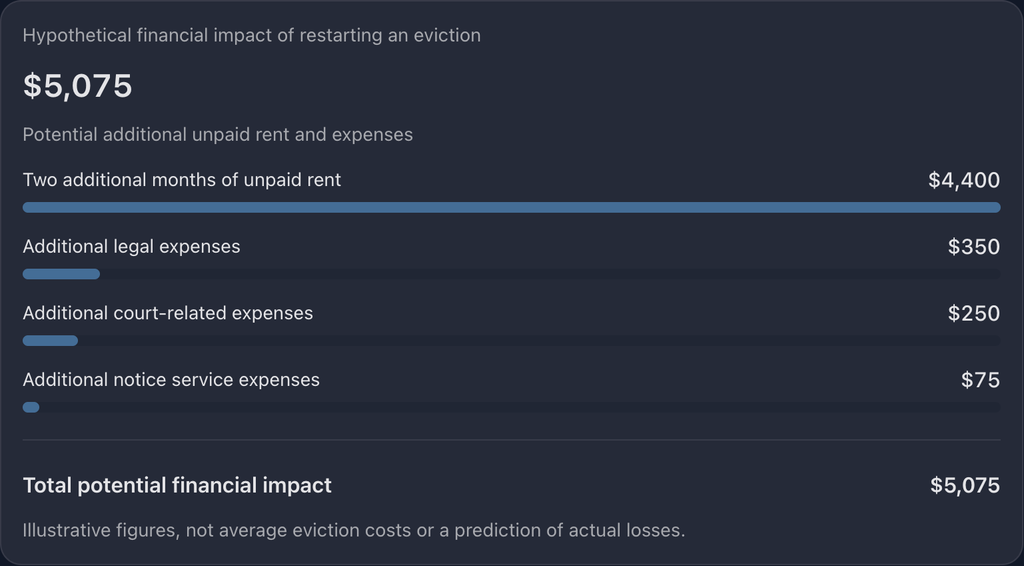
Illustrative figures, not average eviction costs or a prediction of actual losses.
This example does not account for potential property damage, maintenance expenses, mortgage obligations, or other costs associated with operating the rental property.
For landlords managing multiple properties, repeated procedural mistakes can have a substantial impact on overall portfolio performance.
California 3-Day Notice Checklist for Landlords
A consistent administrative review process can help landlords and property managers identify potential eviction notice problems.
The following checklist highlights important areas of consideration before and after serving a California 3-day notice.
Frequently Asked Questions About California 3-Day Notice Mistakes
What makes a 3-day eviction notice invalid in California?
A California eviction notice may be invalid if it contains an inaccurate rent demand, uses the wrong notice type, omits required information, is improperly served, or fails to comply with applicable statewide, local, or federal regulations. Whether a particular mistake invalidates a notice depends on the nature and significance of the defect.
Can a landlord correct a 3-day notice after serving it?
Certain material defects may require preparing and serving a replacement eviction notice. Changing the landlord’s retained copy does not modify the notice previously delivered to the tenant. Serving a replacement notice may also restart the applicable notice period.
Can late fees be included in a California 3-Day Notice to Pay Rent or Quit?
No. A residential 3-Day Notice to Pay Rent or Quit generally must reflect eligible unpaid rent rather than additional charges such as late fees, utilities, returned payment fees, or property damage expenses.
Other legally enforceable financial obligations may require separate collection procedures.
Do weekends count toward a California 3-day eviction notice?
Saturdays, Sundays, and judicial holidays are excluded when calculating the notice period for a 3-Day Notice to Pay Rent or Quit or a 3-Day Notice to Perform Covenants or Quit.
Unconditional 3-day notices generally count weekends and holidays, subject to applicable final-day deadline rules.
Can a California landlord charge a tenant for serving a 3-day notice?
No. Under SB 611, effective February 1, 2025, California landlords and their agents are prohibited from charging tenants fees for delivering, serving, or posting notices described in Code of Civil Procedure Section 1161.
Can a landlord serve a California 3-day notice by email or text message?
Email and text messages generally do not satisfy statutory eviction notice service requirements on their own. California Code of Civil Procedure Section 1162 establishes recognized methods of service, including personal delivery and qualifying substituted or posted service combined with mailing.
Does accepting partial rent invalidate a 3-day notice?
Accepting partial rent after serving an eviction notice may affect its enforceability. Whether payment acceptance constitutes a waiver or otherwise affects the landlord’s ability to proceed depends on the circumstances, timing, and applicable legal requirements.
Can a landlord serve a 3-day notice without giving a warning first?
Some eviction grounds may support a 3-day notice without a separate preliminary warning. However, curable lease violations, local ordinances, and applicable Tenant Protection Act requirements may require prior warnings or opportunities to correct the violation.
The circumstances and location of the rental property are important considerations.
Do Los Angeles landlords have to file 3-day notices with the city?
Applicable notices terminating tenancies at properties covered by the City of Los Angeles RSO or JCO must be filed with the Los Angeles Housing Department within three business days of service on the tenant.
Failure to satisfy this requirement may create an affirmative defense during eviction proceedings.
Can a landlord evict a Los Angeles tenant who owes only one month of rent?
It depends on the amount of unpaid rent and the property’s applicable regulations.
For properties subject to the city’s relevant nonpayment eviction restrictions, outstanding rent must exceed the applicable Fair Market Rent threshold for the rental unit’s bedroom count. One month’s contractual rent may or may not exceed that threshold.
Can an eviction case be dismissed because of an error on a 3-day notice?
Yes. Material defects involving notice contents, service, timing, or statutory compliance can result in dismissal of an unlawful detainer case.
However, not every minor administrative or typographical error automatically invalidates an eviction notice.
Does a 3-day notice mean the tenant must leave after three days?
A 3-day notice establishes a deadline to comply with its terms or surrender possession, depending on the type of notice. It does not authorize the landlord to physically remove the tenant after the deadline.
When the tenant remains in possession, the applicable judicial eviction process generally must follow.
Final Thoughts: Protecting Your California Eviction Case Starts With the Notice
California eviction notice mistakes can turn a relatively straightforward nonpayment or lease violation case into a lengthy and expensive legal dispute.
Accurate rent demands, appropriate notice selection, proper service, detailed documentation, and compliance with applicable rental regulations all play an important role in establishing the foundation of an eviction case.
For Southern California landlords, the increasing complexity of local rental ordinances makes administrative consistency particularly important. A property located in Los Angeles may involve substantially different eviction requirements than a property located in San Bernardino, Riverside, Orange County, or another jurisdiction.
Ultimately, an eviction notice should never be treated as just another property management form. It is a critical document that can directly influence how an eviction proceeds, how long it takes, and how much it ultimately costs the property owner.
Understanding California’s 3-day notice requirements and the mistakes that can undermine an eviction case is an important part of protecting rental income and managing residential rental properties effectively.